The decisions made during the preparation and prosecution of a design patent application, including title selection, drawing view(s), whether to file multiple embodiments, and whether to use an appendix, have lasting consequences. Each of these decisions may impact the scope of protection obtained and the enforceability of the resulting patent. Decisions out of the U.S. Court of Appeals for the Federal Circuit make those consequences very clear.
A design patent protects the new and original, aesthetic or ornamental appearance of an article of manufacture, rather than its function. An accused product that performs the same function but looks different does not infringe. Conversely, a product that looks the same but does not perform the same function may infringe.
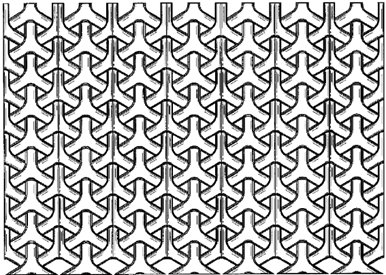
Consider the title and claim first. Under 37 C.F.R. § 1.153, the title of a design patent must designate the particular article in which the design is embodied. That seemingly simple requirement does substantive work, as the Federal Circuit confirmed in Curver Luxembourg, S.A.R.L. v. Home Expressions Inc. The Applicant in Curver originally filed an application directed to a furniture part, but the drawings (shown right) showed only a pattern that was not associated with a furniture article. To satisfy the Examiner’s objection, the Applicant amended the title and claim to read “Pattern for a Chair.” When the Patentee later sued over a basket bearing a similar pattern, the Federal Circuit held that the claim language limited the scope of the patent to chairs, and the basket with the same pattern did not infringe. Had the Applicant pushed back on the Examiner and pursued a broader Title, the scope of the patent may have encompassed the basket pattern.

This same principle cuts both ways. In In re SurgiSil, the Federal Circuit held that a design claim directed to a lip implant (shown left) was novel over an art tool (shown below), even though the two articles looked alike, because the claim was limited by its title to lip implants.

A narrow title can limit scope on the back end, as Curver showed, but it can also help Applicants overcome prior art that would otherwise read on a generic shape. The lesson is that the title is not an afterthought. It is a strategic choice that should be made deliberately, with both prior art and claim scope in mind.
Naturally, the drawings carry even more weight. Line drawings remain preferred in U.S. practice and are the most common format, but photographs and computer-generated images may be acceptable.
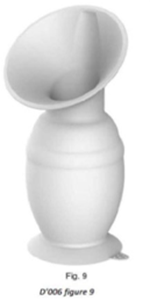
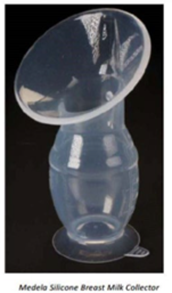
Each format carries risk. In Think Green Limited (d/b/a Haakaa) v. Medela AG, the patentee’s design patent (D808,006) used computer-generated images (shown left), and the district court interpreted the rendered surfaces as indicating a choice of opaque material. The patent, therefore, could not cover a translucent accused product (shown right). A formatting choice that may have seemed like a presentation preference became a substantive limitation on scope.
A related principle, increasingly important in modern U.S. practice, is that fewer drawings tend to produce broader claim scope. The scope of a design patent claim is the appearance of the article as collectively shown across all the drawings. More views generally disclose more specific geometry and, by doing so, may narrow the claim. When visible portions of an article are not shown, it is because they form no part of the claim. The Federal Circuit gave this approach explicit support in In re Maatita, holding that even a single plan-view drawing of a shoe bottom could properly disclose a three-dimensional design, because an ordinary observer could still make the comparison required for infringement. Single-view and reduced-view designs have become more popular as a result, although Examiners do not always agree, and certain foreign jurisdictions require additional views.
This is where an accompanying Appendix becomes a quiet workhorse. Filing additional views, alternative embodiments, or supplemental drawings in an Appendix gives an Applicant flexibility. If prosecution surfaces a problem with the filed views, the Appendix supports possible amendments, including converting solid lines to broken lines or vice versa. If a competitor designs around the issued patent, the Appendix may support a continuation design application directed to the competitor’s design. There is essentially no downside to an Appendix, and the upside can be substantial.
Design Patent Term is an additional piece of the strategic picture, and it is more favorable than many realize. Design patents have a 15-year term measured from issuance, with no maintenance fees. A continuation design patent gets its own 15-year term measured from its issuance. Unlike a utility patent continuation, the parent’s age does not shorten the design term. That asymmetry rewards Applicants who plan a continuation strategy from the start, including the often-overlooked option of filing a design continuation that claims the benefit of a non-provisional utility application.
Design patents are not a checkbox. Treating them as a deliberate strategic instrument, with attention to article designation, drawing economy, and the appendix, produces stronger protection on the front end and fewer surprises on the back end.